DigitAG& twitter

venerdì 11 dicembre 2015

MiT - Active Matter Summit 2015


if you missed, like me, part of the MiT "Active Matter Summit" 2015 here you can find all the videos of the six sessions:

SESSION 1: MATERIAL MAKING
Neil Gershenfeld, MIT - Digital Fabrication & Digital Materials
Peko Hosoi, MIT - Active Soft Materials
Jennifer Lewis, Harvard University - Printing Functional and Active Matter
Rob Wood, Harvard University - Microrobotics
Markus Buehler, MIT - Materials by Design
Neri Oxman, MIT - Material Ecology
>> https://www.youtube.com/watch?v=-dq4fNBzmtU

SESSION 2: BIO-MATERIALS
Peng Yin, Harvard University - Programming DNA
Fiorenzo Omenetto, Tufts University - Silk Polymorphism
Tal Danino, MIT - Programming Bacteria
David Benjamin, The Living - The Living
Suzanne Lee, BioCouture - BioCouture
Paola Antonelli, MoMA - Design & Biology
>> https://www.youtube.com/watch?v=WNaGm_1xtQ4

SESSION 3: MATERIAL TRANSFORMATIONS
Paul McEuen, Cornell University - Graphene Transformations
Pedro Reis, MIT - Programmable Soft Surfaces
Ying Liu / Michael Dickey, NC State University - Soft Material Transformations
Junus Khan, Carbitex - Tunable Carbon Fiber
Christophe Cros, Airbus - Airbus & Programmable Carbon
Christophe Guberan, Product Designer - Active Products
>> https://www.youtube.com/watch?v=xHyYNAZbrk4

SESSION 4: ACTIVE ASSEMBLIES
Skylar Tibbits, MIT - Macro-Scale Self-Assembly
Arthur Olson, The Scripps Research Institute - Biomolecular Self-Assembly
John Main, DARPA - Scalable Directed Assembly
Heinrich Jaeger, University of Chicago - Granular Jammable Materials
Alfredo Alexander-Katz, MIT - Self-Assembly & Soft Materials
Lodovica Illari, MIT - Weather in a Rotating Tank
>> https://www.youtube.com/watch?v=btBOwK9OgyA

SESSION 5: MATERIAL ROBOTICS
John Romanishin / Daniela Rus, MIT - Printable Robotics
Rob MacCurdy / Hod Lipson, Cornell University - Cellular Robotics
Erik Demaine, MIT - Computational Origami
Simon Kim & Mariana Ibanez, University of Pennsylvania & Harvard University - The Immersive
Paul Kassabian, SGH & MIT - Robotic Assembly
Marcelo Coelho, Marcelo Coelho Studio - Computational Matter
>> https://www.youtube.com/watch?v=AgEQH9wrrZI

SESSION 6: ACTIVE ARCHITECTURES
Achim Menges, University of Stuttgart - Material Computation
Chris Lasch, Aranda/Lasch - Architecture, Materials & Structure
Jenny Sabin, Cornell University - Architecture & Biology
Jessica Rosenkrantz &  - Jesse Louis-Rosenberg, Nervous System - Nervous System
Sheila Kennedy, MIT - Matter of Time
Tomás Saraceno, Artist - Material Environments
>> https://www.youtube.com/watch?v=AFE1D-E_pJ4

sabato 17 ottobre 2015

RMIT Architectural Robotics Lab


The RMIT Architectural Robotics Lab is an applied research group that explores the application and implications of robotics to architectural design, building fabrication, assembly and construction. The lab operates to develop both speculative research and the application of that research to industry projects. The lab is situated within RMIT University's d___Lab and operates from the Design Hub.

Link to the RMIT Architectural Robotics Lab

MADLAB.CC - RESEARCH & DESIGN


MADLAB.CC is a design collective exploring computational approaches to architecture, craft, and interaction. Our work merges disciplinary knowledge from architecture, robotics, computer science, human-computer interaction, and design to explore the edges of digital creativity. 

Robo.Op is an open hardware / open software platform for hacking industrial robots (IRs). Robo.Op makes it cheaper and easier to customize your IR for creative use, so you can explore the fringes of industrial robotics. The toolkit is made up of a modular physical prototyping platform, a simplified software interface, and a centralized hub for sharing knowledge, tools, and code. 

Link to MADLAB.CC
Link to Robo.Op

Flying Machine Arena


The Flying Machine Arena (FMA) is a portable space devoted to autonomous flight. Measuring up to 10 x 10 x 10 meters, it consists of a high-precision motion capture system, a wireless communication network, and custom software executing sophisticated algorithms for estimation and control.

The motion capture system can locate multiple objects in the space at rates exceeding 200 frames per second. While this may seem extremely fast, the objects in the space can move at speeds in excess of 10 m/s, resulting in displacements of over 5 cm between successive snapshots. This information is fused with other data and models of the system dynamics to predict the state of the objects into the future.

The system uses this knowledge to determine what commands the vehicles should execute next to achieve their desired behavior, such as performing high-speed flips, balancing objects, building structures, or engaging in a game of paddle-ball. Then, via wireless links, the system sends the commands to the vehicles, which execute them with the aid of on-board computers and sensors such as rate gyros and accelerometers.

Although various objects can fly in the FMA, the machine of choice is the quadrocopter due to its agility, its mechanical simplicity and robustness, and its ability to hover. Furthermore, the quadrocopter is a great platform for research in adaptation and learning: it has well understood, low order first-principle models near hover, but is difficult to characterize when performing high-speed maneuvers due to complex aerodynamic effects. We cope with the difficult to model effects with algorithms that use first-principle models to roughly determine what a vehicle should do to perform a given task, and then learn and adapt based on flight data.

Link to the FMA

MaP+S - Material Processes and Systems Group at Harvard GSD


The Materials, Processes, and Systems (MaPS) Group, lead by Professor Martin Bechthold, is a research unit that promotes the understanding, development and deployment of innovative technologies for buildings. The group evolved from the previously established Design Robotics Group, and is located in a research cluster at the Harvard Graduate School of Design. MaPS looks at materiality as starting points for design research, with a special interest in robotic and computer-numerically controlled (CNC) fabrication processes as well as small scale work on nano-materials. Much of our current work studies ceramic material systems and design robotics. MaPS also runs the Adaptive Living Environments (ALivE) project jointly with Harvards REAL group. ALivE develops novel applications for nano-scale material systems developed jointly with scientists from the Wyss Institute for Biologically Inspired Engineering.

Link to MaP+S

mercoledì 15 ottobre 2014

The Grasshopper Primer Third Edition | Foundations by Modelab


Modelab just released the new Grasshopper Primer called 'The Grasshopper Primer Third Edition | Foundations'. A big Thank You is really deserved.

Link to 'The Grasshopper Primer Third Edition | Foundations' webpage

Interactive Architecture


The Interactive Architecture Lab is a multi-disciplinary research group and Masters Programme at the Bartlett School of Architecture, University College London. Interested in the Behaviour and Interaction of Things, Environments and their Inhabitants.

Link to Interactive Architecture
Link to 'Scorpion – Robotics Controller'
Link to 'Furl: Soft Pneumatic Pavilion'

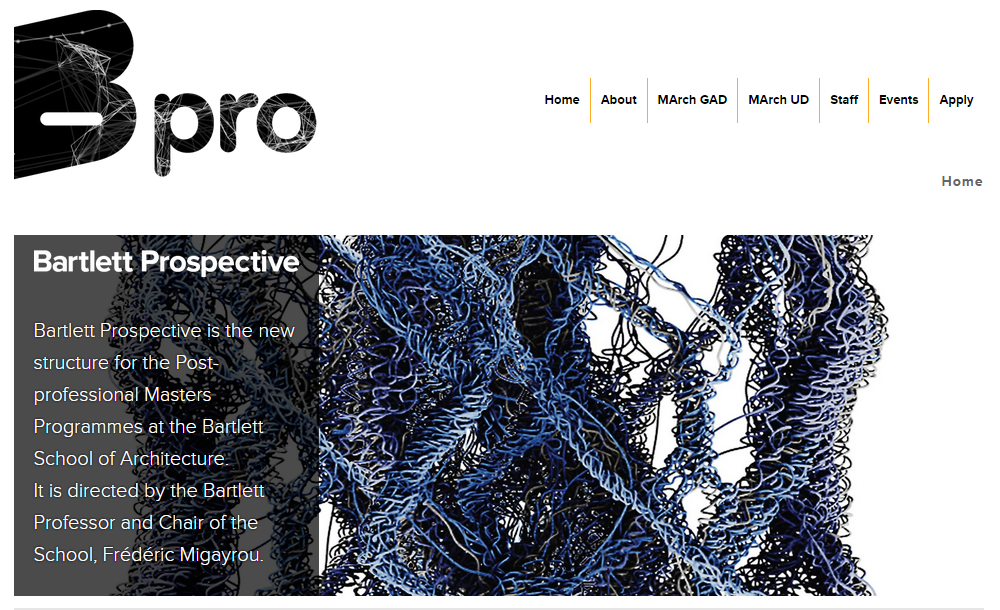
B-pro


Bartlett Prospective is the new structure for the Post-professional Masters Programmes at the Bartlett School of Architecture.

Link to B-pro

HyperCell


HyperCell - The research is focused on aspects of self-assembly, fabrication and prototyping.

Link to HyperCell

ShapeOp


ShapeOp is a header-only C++ library for static and dynamic geometry processing, using a unified framework for optimization under constraints. Examples of its applications include architectural design subject to geometric constraints, and physics simulation of elastic materials. It is developed by the Computer Graphics and Geometry Laboratory of EPFL, in collaboration with Daniel Piker and Anders Holden Deleuran. It is released under Mozilla Public License Version 2.0.

Link to ShapeOp

Digital Matter - Intelligent Constuctions


The Intelligent Constructions research line wishes to explore how Digital Fabrication goes beyond assigning material properties into rigid construction components. The group works with digital content, information and fabrication for the generation of new techniques generating the production of non-rigid, responsive and multi-functional material and construction systems. Hence generating an architecture that is not just mimicking the living but is roaring into life.

Link to Digital Matter - Intelligent Constuctions

Gozour Workshops


Gozour Workshops - Parametric Design Tutorials and Guide Files

Link to Gozour Workshops

Shaping Behaviour


SHAPING BEHAVIOUR    revolves around the psychological and physical aspects of morphogenesis. From a psychological point of view, shaping refers to the INFLICTED, CAUSED and or TRAINED TRANSFORMATIONS of the behaviour of an organism/object – which we are addressing through computation. The physical meaning refers to the formal outline and/or geometry of a given object – this being both a two dimensional or three dimensional results of the ongoing COMPUTATIONAL EXPERIMENTATIONS. Since we are not interested in static experiments, nor in the direct results, behavior is referring to the PROCESS and the INTENSIVE USAGE of agent based algorithms and systems.

Link to Shaping Behaviour

Cellular Complexity


Cellular Complexity is a design-research collaboration between Kais Al-Rawi, Julia Koerner and Marie Boltenstern established in 2012 at the Architectural Association London. The Research investigates complex cellular systems and their potential for architectural applications that utilize efficient space-packing geometries with a special focus on emergent technologies in Architecture and Design.

Link to Cellular
Complexity

Diagramming Machines


Diagramming Machines - Writings on computational and generative design

Link to Diagramming Machines

Spatial Pixel


Spatial Pixel is a resource for computational designers, covering emerging topics like algorithmic design, automated reasoning, design computation, optimization, and more.

Link to Spatial Pixel

Tyrertecture


Tyrertecture is the blog of designer and lecturer Nick Tyrer

Link to Tyrertecture

martedì 18 marzo 2014

CAM NEWNHAM


The website of Cameron Newnham contains many interesting resources as Python and Processing scripts.

Link to 'CAM NEWNHAM' website
Link to 'Rhino to Processing and Back'
Link to 'Cellular Automata'
Link to 'Fibrosity: Tech Specs'

FreeCAD - parametric 3D modeler


FreeCAD is a parametric 3D modeler. Parametric modeling allows you to easily modify your design by going back into your model history and changing its parameters. FreeCAD is open source (LGPL license) and completely modular, allowing for very advanced extension and customization.

FreeCAD features tools similar to Catia, SolidWorks or Solid Edge, and therefore also falls into the category of MCAD, PLM, CAx and CAE. It is a feature based parametric modeler with a modular software architecture which makes it easy to provide additional functionality without modifying the core system.

FreeCAD is multiplatfom, and reads and writes many open file formats such as STEP, IGES, STL and others.

Link to FreeCAD website
Link to an interesting 'Arch Tutorial'

mercoledì 26 febbraio 2014

Computational Design Lab


The Computational Design Lab at Carnegie Mellon University is a multidisciplinary collaborative formed to address complex issues at the intersection of art, design, architecture, and engineering.

Link to 'Computational Design Lab' website